 blog
Supplements to Avoid with Hashimoto Thyroiditis
Table of Contents
- Why Supplement Safety Matters with Hashimoto Thyroiditis
- Iodine and Hashimoto's Thyroiditis: The Most Common Trigger
- Supplements That Interfere with Thyroid Medication Absorption
- Biotin and Thyroid Blood Tests: A Dangerous Combination
- Selenium Supplements for Hashimoto's: Helpful or Harmful?
- Other Supplements to Avoid with Hashimoto Thyroiditis
- How to Separate Supplements from Thyroid Medication: A Practical Timing Schedule
- How to Assess Supplement Labels and Combination Products
- Who May Still Need Supplementation Despite These Cautions
- Conclusion: Work with a Professional, Not the Supplement Aisle
- Frequently Asked Questions
Last Updated: October 18, 2026
Why Supplement Safety Matters with Hashimoto Thyroiditis
Hashimoto thyroiditis is an autoimmune condition in which the immune system attacks the thyroid gland, often leading to hypothyroidism and a lifelong need for thyroid hormone replacement. For people living with this condition, the supplement aisle is a minefield. The wrong product can worsen thyroid function, block medication absorption, or skew the blood tests your doctor relies on.
At Thyroid Authority, we see this problem constantly. Many patients arrive frustrated, taking several supplements and feeling worse than before. Below, we break down exactly which supplements to avoid with Hashimoto thyroiditis, why they cause harm, and how to time the ones you genuinely need.
This is general information, not medical advice. Always talk to your prescribing clinician before starting or stopping any dietary supplement.
Iodine and Hashimoto's Thyroiditis: The Most Common Trigger
Iodine is the supplement most likely to cause trouble in Hashimoto's. The thyroid needs iodine to make thyroid hormone, so it seems logical that more would help. In autoimmune thyroid disease, the opposite is often true.
Excess iodine can fuel thyroid peroxidase antibodies, or TPO antibodies, and may push an already irritated immune system harder. Many clinicians advise against high-dose iodine for anyone with Hashimoto's. A common approach is to get iodine from food sources and avoid concentrated supplements unless a clinician specifically recommends them after testing.
The tricky part is that iodine hides in products marketed as natural. Keep an eye out for:
- Kelp and bladderwrack
- Sea moss gummies and powders
- "Thyroid support" formulas with iodine listed
- Multivitamins with added iodine above the daily requirement
If you are unsure whether a product contains iodine, read the Supplement Facts panel closely. Iodine is sometimes listed under a proprietary blend, which makes the dose impossible to verify.
Kelp, Sea Moss, and Seaweed Supplements
Kelp, sea moss, and seaweed supplements deserve their own warning. These products are concentrated sources of iodine, and the amount varies wildly from batch to batch. A single kelp capsule can deliver far more iodine than a person with Hashimoto's should take in a day.
Sea moss has become a social media favorite, often sold as a gel or gummy with vague claims about thyroid health. There is no reliable way to know how much iodine you are getting. For someone with autoimmune thyroid disease, that uncertainty is a real risk. Our recommendation is simple: skip these products unless your clinician has reviewed the label and approved the dose.
Supplements That Interfere with Thyroid Medication Absorption
Even supplements that have nothing to do with the thyroid can interfere with thyroid medication. Levothyroxine, the most common thyroid hormone replacement, is sensitive to what else is in your stomach. Certain minerals bind to it and reduce how much your body absorbs.
When absorption drops, your thyroid-stimulating hormone can rise, and symptoms creep back. This is one of the most underrated reasons people feel fine for months and then suddenly crash.
Calcium and Iron: The Biggest Absorption Blockers
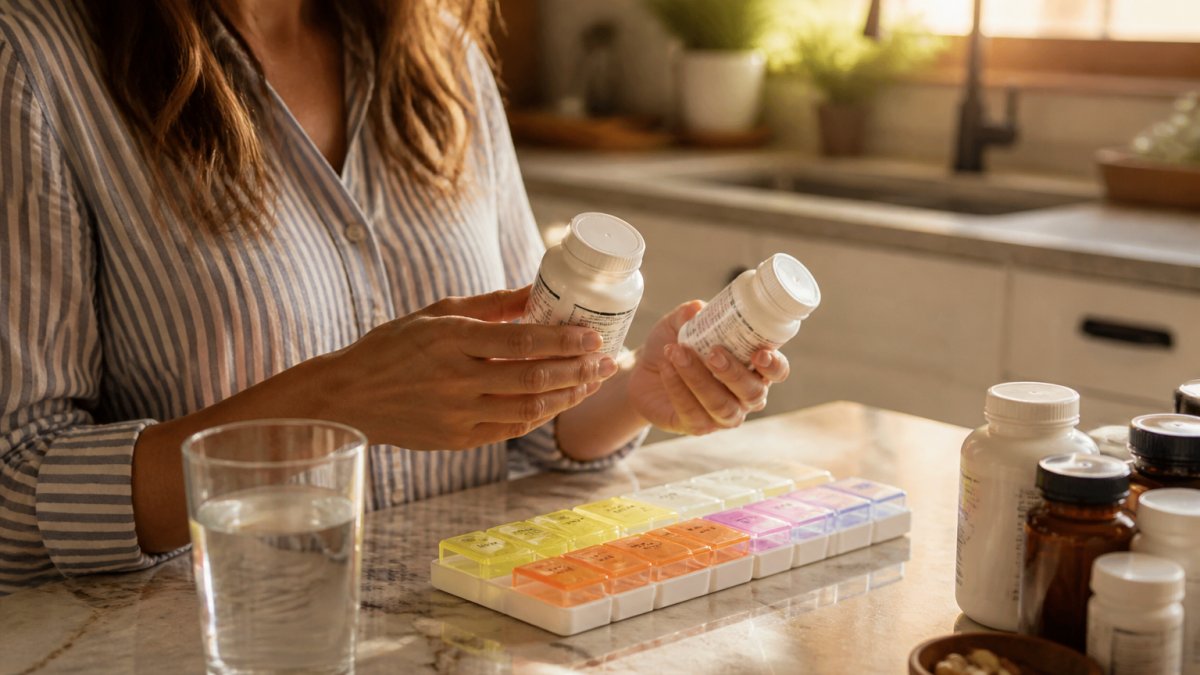
Calcium and iron are the two most well-known absorption blockers. Both bind to levothyroxine in the gut and lower the amount that reaches your bloodstream. This does not mean you should avoid calcium or iron. It means you need to separate them from your thyroid medication.
A practical rule many clinicians use is to take levothyroxine on an empty stomach and wait at least four hours before calcium or iron. Some people need a longer gap. Multivitamins often contain both minerals, so treat them the same way.
Biotin and Thyroid Blood Tests: A Dangerous Combination
Biotin is the supplement most likely to give you a false sense of security. Sold for hair, skin, and nails, biotin can distort thyroid blood tests, including TSH and thyroid hormone measurements. The result is a lab report that looks normal or even hyperthyroid when your actual thyroid function is different.
This matters because your dose is adjusted based on those numbers. A skewed test can lead to a dose change you did not need. The fix is straightforward: stop biotin at least two to three days before thyroid labs, and tell your clinician you take it. FDA safety communication on biotin and lab tests explains how biotin interferes with certain lab assays.
Selenium Supplements for Hashimoto's: Helpful or Harmful?
Selenium is the one supplement with a plausible benefit for Hashimoto's, but the evidence is mixed, dose matters enormously, and the gap between "lowers antibodies" and "makes you feel better" is wider than most supplement marketing admits.
Here is what the research actually shows, graded honestly:
- Antibody reduction (moderate evidence): Several randomized trials in people with autoimmune thyroid disease found that selenium supplementation lowered thyroid peroxidase (TPO) antibodies compared with placebo. The effect is real but modest, and it does not reliably translate into improved symptoms or thyroid function.
- Symptom and function improvement (weak evidence): Studies looking at whether selenium improves fatigue, quality of life, or levothyroxine requirements have been inconsistent. Some show small benefits; others show none. No trial has demonstrated that selenium slows the progression of Hashimoto's itself.
- Clinical outcomes (insufficient evidence): There is no good evidence that selenium prevents hypothyroidism, reduces the need for thyroid medication long-term, or changes the course of the disease.
That distinction matters. A lower antibody number on a lab report can feel reassuring, but antibodies fluctuate on their own and are not a reliable proxy for how you feel or how your thyroid is functioning. If your clinician suggests selenium, the goal should be a measured trial with repeat labs, not an indefinite supplement habit.
Dose Thresholds and the Upper Limit
Selenium has a narrow safe range, and the difference between a helpful dose and a harmful one is smaller than most people assume.
- Recommended dietary allowance (RDA): 55 micrograms per day for adults.
- Tolerable upper intake level (UL): 400 micrograms per day for adults, the maximum daily intake unlikely to cause harm. This is a ceiling, not a target.
- Supplement doses in trials: Commonly 100 to 200 micrograms per day of selenomethionine. Doses at or above 400 micrograms per day raise the risk of toxicity.
Selenium toxicity is not subtle. Too much can cause hair loss, brittle or discolored nails, garlic-like breath, digestive upset, and in severe cases nerve damage. Brazil nuts are a concentrated food source, a single Brazil nut can contain roughly 70 to 90 micrograms of selenium, so a handful plus a supplement can easily push you past the upper limit. NIH Office of Dietary Supplements selenium fact sheet outlines the upper limit, food sources, and toxicity signs.
Our View
Selenium is worth discussing with your clinician, not something to self-prescribe at high doses. If you and your clinician decide to trial it, use a single-ingredient product with a clearly stated dose, stay well under the 400-microgram upper limit, account for selenium in your multivitamin and diet, and recheck antibodies and thyroid function at a defined interval. If there is no measurable benefit, stop. At Thyroid Authority, we treat selenium as a time-limited, monitored trial rather than a permanent fixture in the supplement stack, one of many reasons our patients stop guessing which bottle is helping and which is quietly working against them.
Other Supplements to Avoid with Hashimoto Thyroiditis
Beyond iodine, calcium, iron, and biotin, a handful of other products deserve caution, and the reason they are risky is usually the same: vague claims, hidden ingredients, and doses you cannot verify. This is where reading the label matters more than reading the front of the bottle. Hidden sources of this mineral often lurk in common hygiene items, making it essential to prioritize iodine-free product options when selecting your daily essentials.
Collagen, Guggul, and Herbal Blends
Collagen. Collagen is popular for joints and skin, and plain collagen is generally not a thyroid concern. The problem is fortified or marine versions. Some collagen powders add kelp or iodine for "thyroid support," and marine collagen can carry naturally occurring iodine. Check the Supplement Facts panel for iodine, kelp, or seaweed before you buy.
Guggul. Guggul is an herbal extract marketed for thyroid support. It can interact with thyroid medication and alter thyroid hormone levels, and it is not appropriate to combine with levothyroxine without clinician oversight. The dose in herbal products is often inconsistent from batch to batch.
Herbal blends and "thyroid boosters." This is the hardest category because the label rarely lists every ingredient or its dose. Products that promise to "support thyroid function" or "boost metabolism" frequently contain iodine, kelp, or stimulant herbs, sometimes hidden inside a proprietary blend. Treat those claims as a reason for extra scrutiny, not less.
- Marine collagen with added kelp
- Guggul and thyroid "boosters"
- Detox teas with stimulant herbs
- Proprietary blends with hidden iodine
- "Metabolism" or "energy" formulas with undisclosed stimulants
How to Spot Hidden Iodine, Calcium, and Iron in Combination Products
The biggest trap is not a single-ingredient bottle, it is the combination product. A single "hair, skin, and nails" formula can contain biotin, iodine, and selenium all at once. A "bone health" product can pair calcium with vitamin D and magnesium. A "thyroid support" blend can stack iodine, selenium, and kelp in doses you never intended.
Use this label checklist before buying anything:
- Does it list iodine, kelp, bladderwrack, or sea moss? If yes, skip it unless your clinician approves.
- Does it contain biotin? Stop it at least two to three days before thyroid labs.
- Does it contain calcium or iron? Separate it from levothyroxine by at least four hours.
- Does it contain selenium, and at what dose? Add up every source, including your multivitamin.
- Is the dose listed per ingredient, or hidden in a proprietary blend?
- Does the label make disease claims? That is a red flag, not a feature.
Combination products also create overlap problems. If you take a multivitamin, a separate selenium capsule, a biotin gummy, and a "thyroid support" blend, you may be doubling or tripling doses of the same ingredients without realizing it. FTC guidance on health claims in advertising reminds consumers that supplement marketing claims are not the same as proof.
At Thyroid Authority, we see the same pattern repeatedly: patients arrive taking several products, some of which overlap or contain hidden iodine. Dr. Jason Bradley, who has over 26 years of thyroid and functional medicine expertise, and Dr. Rachel, Vice President of the American Board of Nutrition, routinely help patients strip their stack down to what is tested, timed, and actually needed. That is the goal, not more supplements, but the right ones, verified.
How to Separate Supplements from Thyroid Medication: A Practical Timing Schedule
Timing is where most people can fix the problem without giving up supplements they need. The goal is to keep levothyroxine away from anything that binds it or changes absorption.
Here is a schedule many clinicians find workable. Confirm it with your own prescriber, since your dose and other conditions matter.
| Time | What to Take | Notes |
|---|---|---|
| On waking, empty stomach | Levothyroxine | Wait 30-60 minutes before food |
| Mid-morning | Breakfast, then vitamin D, B12 | Keep calcium and iron out of this window |
| Lunch | Calcium or iron supplement | At least 4 hours after levothyroxine |
| Evening | Magnesium, CoQ10 | Separate from calcium and iron |
| 2-3 days before labs | Stop biotin | Tell your clinician |
The takeaway: separate, do not eliminate. Move the interacting supplement, then recheck your labs.
How to Assess Supplement Labels and Combination Products
Labels are where supplement safety is won or lost. A product can call itself "thyroid friendly" and still contain iodine, biotin, or a dose of selenium you do not need. Read the Supplement Facts panel, not the front of the bottle.
Use this checklist before buying anything:
- Does it list iodine, kelp, or sea moss? If yes, skip it unless approved.
- Does it contain biotin? Stop it before labs.
- Does it contain calcium or iron? Separate it from levothyroxine.
- Is the dose listed per ingredient, or hidden in a proprietary blend?
- Does it contain selenium, and at what dose?
- Does the label make disease claims? That is a red flag.
Combination products are the biggest trap. A single "hair, skin, and nails" formula can contain biotin, iodine, and selenium all at once. FTC guidance on health claims in advertising reminds consumers that supplement marketing claims are not the same as proof.
Who May Still Need Supplementation Despite These Cautions
Not everyone should avoid supplements. Some people with Hashimoto's have real deficiencies that need treatment, and skipping them causes its own problems.
You may still need supplementation if you have:
- A documented vitamin D deficiency
- Low vitamin B12, common with long-term thyroid medication use
- Iron deficiency confirmed by labs
- Restricted diet or absorption issues
The difference is testing. A deficiency confirmed by blood work is a reason to supplement under supervision. A hunch is not. This is exactly where a physician-led approach beats guessing at the supplement aisle, and it is the core of how Thyroid Authority works with patients. Our 12-month virtual program, built on the EPIC Five™ Framework, focuses on finding the root cause rather than stacking products. You can book a complimentary discovery session to talk through your own situation.
Conclusion: Work with a Professional, Not the Supplement Aisle
The supplement aisle is designed to sell, not to treat Hashimoto's. Iodine, kelp, sea moss, calcium, iron, biotin, and high-dose selenium all carry real risks for people with autoimmune thyroid disease. The good news is that most problems come down to two fixes: choose products carefully, and separate them from your thyroid medication.
If you are tired of guessing which bottle is helping and which is hurting, work with a clinician who will test, time, and monitor. Thyroid Authority pairs physician-led care with a structured 12-month plan so you can stop managing symptoms and start addressing the root cause.
Frequently Asked Questions
Can iodine supplements make Hashimoto's worse?
Yes, for many people. Iodine is essential for thyroid hormone production, but in Hashimoto's thyroiditis the immune system is already attacking the thyroid. Excess iodine can increase thyroid peroxidase antibodies and trigger or worsen hypothyroidism in some people. Kelp, sea moss, and seaweed supplements often contain very high iodine levels, sometimes far above the daily requirement, and are best avoided unless a doctor specifically recommends them. If you are considering iodine, discuss it with a clinician who understands autoimmune thyroid disease first.
Which supplements interfere with thyroid medication?
Calcium, iron, magnesium, and multivitamins with minerals can bind levothyroxine in the gut and reduce how much your body absorbs. Biotin can distort thyroid blood tests, making TSH look falsely low and free T4 look falsely high. Collagen and some herbal blends may also affect absorption or immune function. The practical rule is to take thyroid medication on an empty stomach and separate it from these supplements by at least four hours, then confirm with your doctor before adding anything new.
Should people with Hashimoto's avoid biotin before thyroid blood tests?
Yes. Biotin, often found in hair, skin, and nail supplements and multivitamins, can interfere with many lab assays used to measure TSH, free T4, and free T3. The result can look like hyperthyroidism when you are actually hypothyroid, or mask a real problem. Most labs recommend stopping biotin at least two to three days before thyroid blood tests, but follow the specific instructions from your doctor or lab. Always tell your provider about every supplement you take before testing.
Can selenium supplements be harmful with Hashimoto's?
Selenium can be helpful in modest amounts because it supports thyroid peroxidase and may lower TPO antibodies in some studies, but high doses can cause hair loss, brittle nails, nausea, and other toxicity symptoms. The upper limit for adults is 400 micrograms per day from all sources, and Brazil nuts are very high in selenium, so watch total intake. Food sources like eggs and tuna are generally safer than high-dose supplements. Ask your doctor to check your levels before starting selenium for Hashimoto's.
Living with Hashimoto's is hard enough without a supplement cabinet working against you. If you want a physician-led plan that accounts for your medications, your labs, and your history, Thyroid Authority offers a 12-month virtual program built on the EPIC Five™ Framework. Get started with Thyroid Authority and take back control of your health.