 how-to
How Long Does Gut Microbiome Testing Take? 2026 Guide
Table of Contents
- Why Gut Microbiome Testing Takes as Long as It Does
- The Step-by-Step Timeline: From Sample Collection to Your Test Report
- How Long Does It Take to Get Gut Microbiome Test Results?
- Gut Microbiome Test Accuracy: What Affects Diagnostic Accuracy
- What Does a Gut Microbiome Test Reveal About Your Health?
- Factors That Can Delay Your Turnaround Time
- Actionable Post-Test Timelines: What to Do After Results Arrive
- Common Mistakes to Avoid During Gut Microbiome Testing
- Frequently Asked Questions
Last Updated: September 25, 2026
Why Gut Microbiome Testing Takes as Long as It Does
Most people expect a gut microbiome test to work like a blood draw: give the sample, get the answer. It doesn't. Gut microbiome testing is a multi-stage process, and each stage adds time for a reason.
The short answer: a stool-based gut microbiome test usually takes two to four weeks from the day you ship your sample to the day you get your report. Some labs move faster. Others take longer.
At Thyroid Authority, we see this question constantly from people who feel dismissed by normal lab results and want deeper answers. This guide breaks down every stage of the timeline, what can slow it down, and what to do once your results land.
Here's what most guides skip: the delay isn't one bottleneck. It's four separate ones stacked together.
NIH Human Microbiome Project overview
The Step-by-Step Timeline: From Sample Collection to Your Test Report
The full journey runs through four phases: collection, shipping, lab processing, and reporting. Each phase has its own clock.
Here's the breakdown:
| Phase | Typical Time | What Happens |
|---|---|---|
| At-home collection | 5-20 minutes | You collect and seal the stool sample |
| Shipping to lab | 1-5 days | Sample travels in a stabilized kit |
| Lab processing | 3-10 days | DNA extraction and sequencing |
| Analysis and report | 2-7 days | Bioinformatics and data interpretation |
Total: roughly 2-4 weeks. Now let's walk through each phase.
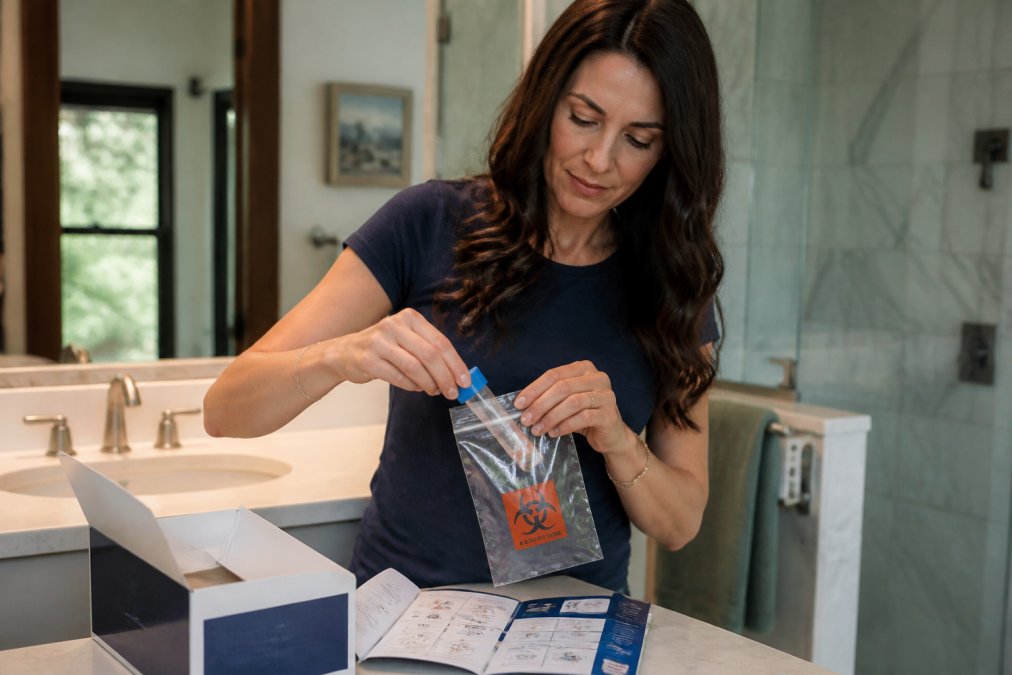
Collecting Your Stool Sample at Home
Sample collection is the fastest part. Most at-home test kits take five to twenty minutes to complete.
You'll typically get a collection tube, a swab or scoop, gloves, and a prepaid shipping box. The kit instructions matter more than people think. A common mistake is collecting too little material or letting the sample sit at room temperature too long before sealing it.
Follow the kit's directions exactly. Contaminated or under-filled samples get rejected, and a rejected sample means starting over.
Shipping Logistics and Sample Stability
This is the phase most guides ignore, and it's where delays hide. A stool sample is a living biological specimen. Gut bacteria begin to change the moment the sample leaves your body.
Labs solve this with stabilization buffers or preservatives inside the kit. These chemicals lock the bacterial community in place so the sample still reflects your gut at the time of collection.
Two things slow shipping down:
- Weekends and holidays, when labs don't receive deliveries
- Weather events that delay carriers
Ship on a Monday or Tuesday when you can. It's a small habit that saves days.
Laboratory Processing and Sequencing Technology
Once your sample arrives, the real work starts. Lab processing usually takes three to ten days.
The lab extracts bacterial DNA from your sample. Then sequencing technology reads the genetic material to identify which bacteria are present and in what amounts. Many labs use 16S rRNA sequencing, which targets a specific bacterial gene. Others use shotgun metagenomics, which reads all the DNA in the sample.
Shotgun methods give more detail. They also take longer and cost more to run. That trade-off is one reason turnaround times vary so much between labs.
How Long Does It Take to Get Gut Microbiome Test Results?
Most people get their gut microbiome test results two to four weeks after shipping the sample. The exact window depends on the lab's sequencing method, its current sample volume, and how fast your kit ships.
Some commercial labs advertise faster windows. Read the fine print. "Results in days" often means days after the lab receives and processes the sample, not days after you mail it.
A few practical benchmarks:
- Collection and shipping: 2-7 days
- Lab receipt to sequencing start: 1-3 days
- Sequencing and quality checks: 2-7 days
- Report generation: 2-7 days
If you're tracking a health marker over time, plan around a month per test. That pacing matters for longitudinal tracking.
Gut Microbiome Test Accuracy: What Affects Diagnostic Accuracy
No gut microbiome test is perfectly standardized, and that's the honest truth most marketing pages skip. Test accuracy depends on sample stability, sequencing method, and how the lab interprets the data.
Here's the core problem: two labs can test the same sample and report different bacterial profiles. Why? Because they use different methods, different reference databases, and different algorithms for data interpretation. This is the standardization versus proprietary methods debate, and it's unresolved across the industry.
The sequencing method is the biggest variable. Most labs use one of two approaches:
- 16S rRNA sequencing targets a specific bacterial gene. It's faster, cheaper, and good at identifying which broad groups of bacteria are present. It cannot tell you what those bacteria are doing.
- Shotgun metagenomics reads all the DNA in the sample. It identifies species-level detail and can flag genes tied to specific functions, like fiber breakdown or inflammation signaling. It takes longer to run, costs more, and generates far more data to interpret.
That trade-off is why turnaround times vary so much between labs. A lab running 16S can often return results in days. A lab running shotgun metagenomics may need a week or more just for sequencing and quality checks.
Day-to-day variability is the other factor most people miss. Your gut bacteria shift with what you eat, how you sleep, and how stressed you are. A single test is a snapshot, not a permanent record. Two samples taken a week apart from the same person can show meaningful differences, not because the test is wrong, but because the microbiome is dynamic.
What you can control:
- Choose a lab that publishes its methodology
- Collect your sample exactly as directed
- Ship promptly using the provided materials
- Avoid collecting a sample right after antibiotics
- Test at the same time of day and under similar conditions if you're tracking changes over time
Antibiotics wipe out large portions of the bacterial community and can skew results for weeks. Wait until your doctor confirms it's appropriate to test.
At Thyroid Authority, we see this play out constantly. Dr. Rachel, who serves as Vice President of the American Board of Nutrition, has spent over a decade and a half working in both hospital and private settings specializing in nervous system regulation and identifying the missing nutritional components that often perpetuate chronic illness. She'll tell you the same thing: a single snapshot without clinical context is just noise. The pattern over time is what matters.
Cleveland Clinic overview of the gut microbiome
What Does a Gut Microbiome Test Reveal About Your Health?
A gut microbiome test reveals the types and relative amounts of bacteria living in your digestive tract. It can also flag markers linked to digestive health, inflammation, and how well your gut breaks down food.
Reports commonly include:
- Microbial diversity: how many different bacterial species are present
- Bacterial community balance: ratios of beneficial versus potentially harmful groups
- Metabolic markers: compounds bacteria produce that affect digestion and immunity
- Digestive health signals: clues about fiber breakdown and gut lining health
Some advanced labs add metabolomics, transcriptomics, or proteomics. These look at what the bacteria are actually doing, not just which ones are there. That's a meaningful step up in health insights.
What a test cannot do is diagnose a condition on its own. It's one data point. A physician who understands your full history has to interpret it in context.
This is where Thyroid Authority's approach differs. The EPIC Five™ Framework looks at gut health as one piece of a larger root-cause picture, alongside thyroid function, nutrition, and nervous system regulation. Testing is a starting point, not a finish line.
Cleveland Clinic overview of the gut microbiome
Factors That Can Delay Your Turnaround Time
Turnaround time stretches when any single phase slows down. The most common culprits:
- Weekend shipping: samples that sit over a weekend lose days
- Rejected samples: too little material, leakage, or missed stabilization steps
- High lab volume: busy periods push samples into a queue
- Weather and carrier delays: winter storms and regional disruptions
- International shipping: customs can add a week or more
- Re-test requests: if quality checks fail, the lab may ask for a new sample
Day-to-day variability matters too. Your gut bacteria shift with what you eat, how you sleep, and how stressed you are. A single test is a snapshot, not a permanent record.
Actionable Post-Test Timelines: What to Do After Results Arrive
Your report is not the end of the process. What you do in the weeks after matters more than the test itself.
Here's a practical timeline:
Week 1 after results: Read the report with a clinician, not alone. Highlight the markers that fall outside normal ranges.
Weeks 2-4: Start one or two changes. Common starting points include adding fiber-rich foods, trying a targeted probiotic, or adjusting meal timing.
Weeks 4-8: Track how you feel. Energy, digestion, and brain fog are the signals most people notice first.
Months 3-6: Consider a retest to see whether your bacterial community shifted.
Months 6-12: Refine the plan based on what the retest shows.
This pacing is deliberate. Gut bacteria respond to change slowly, and rapid overhauls make it impossible to tell what worked.
At Thyroid Authority, this is the work our 12-month program is built around. Dr. Jason Bradley, who serves as Vice President of the American Board of Functional Medicine, has spent over 26 years helping patients connect gut health, thyroid function, and autoimmune symptoms into one picture. Our team has helped thousands of patients restore energy and clarity by working from root causes rather than symptoms alone.
Common Mistakes to Avoid During Gut Microbiome Testing
Most disappointing test experiences trace back to a handful of avoidable errors.
- Collecting the sample at the wrong time. Right after antibiotics or a stomach bug gives you a distorted baseline.
- Skipping the stabilization step. If your kit has a preservative, use it exactly as directed.
- Shipping late in the week. A Thursday drop-off often means a Monday arrival.
- Changing your diet right before testing. A sudden shift skews the snapshot.
- Reading the report alone. Data interpretation without clinical context leads to panic or false comfort.
- Expecting a diagnosis. A microbiome test shows patterns, not answers by itself.
A common mistake is treating one test as a verdict on your health. It's a data point.
Gut microbiome testing takes time because biology takes time. From sample collection to laboratory processing, every stage exists to protect the accuracy of your results. Rushing any step costs you clarity later.
If you've been told your labs are normal while still feeling exhausted, foggy, or stuck, the missing piece may sit outside a standard thyroid panel. Thyroid Authority was built for exactly that gap. Our physician-led, 12-month virtual program uses the EPIC Five™ Framework to connect gut health, thyroid function, and nervous system regulation into one root-cause plan, led by doctors who have walked this path themselves.
Start with a complimentary discovery session and find out whether the program fits your situation.
Frequently Asked Questions
Is a gut microbiome test worth it?
It depends on your goals. A gut microbiome test reveals bacterial diversity, potential imbalances, and health markers that can guide personalized nutrition and probiotic choices. For people with persistent digestive issues or autoimmune conditions like Hashimoto's, the insights may help a physician tailor a root-cause plan. However, results are not diagnostic on their own. Discuss findings with a qualified professional before making major changes.
What factors influence the turnaround time for microbiome analysis?
Several factors affect how long gut microbiome testing takes: shipping distance and weather, sample stability during transit, the laboratory's current workload, and the sequencing technology used. At-home kits typically take 2-4 weeks from collection to report, while clinical diagnostics may be faster if processed in-house. Day-to-day variability in your microbiome can also influence whether a lab requests a repeat sample.
Will insurance pay for a gut microbiome test?
Most insurance plans do not cover direct-to-consumer gut microbiome testing because it is considered elective or investigational. Some clinical diagnostics ordered by a physician for specific gastrointestinal symptoms may be covered, depending on your plan and medical necessity. Check with your insurer before ordering. Thyroid Authority's program does not bill insurance but provides physician-led interpretation of results as part of care.
How accurate are gut microbiome tests?
Accuracy varies by method. Sequencing-based tests that use standardized calibration and bioinformatics pipelines tend to be more reliable than proprietary methods without validation. Factors like sample collection technique, shipping delays, and day-to-day variability in your gut bacteria can affect results. For clinical decision-making, choose tests with published scientific validation and have a physician interpret the report alongside your symptoms.